
What if the biggest constraint on artificial intelligence is access to electricity?
By Chinmay Shah | November 2026
The AI infrastructure race is exposing a fundamental mismatch between the speed of digital innovation and the pace of electrical infrastructure development. Computing hardware can evolve within months. Building generation capacity, expanding transmission networks and securing utility connections can take years.
The International Energy Agency projects global data center electricity consumption to rise from approximately 485 TWh in 2025 to 950 TWh by 2030 [1]. For developers, this creates a strategic question: should they wait for the grid or build their own power infrastructure? Behind-the-meter (BTM) generation is increasingly being evaluated as a mechanism to accelerate commercial operations, with implications for how electrical equipment is designed, purchased and integrated.
1. From backup power to primary infrastructure
Historically, data centers relied on utility electricity for normal operation, supported by UPS systems and emergency generators. Dedicated BTM generation operates on the customer side of the metering boundary and can supply some or all facility demand. It does not necessarily mean abandoning the grid.
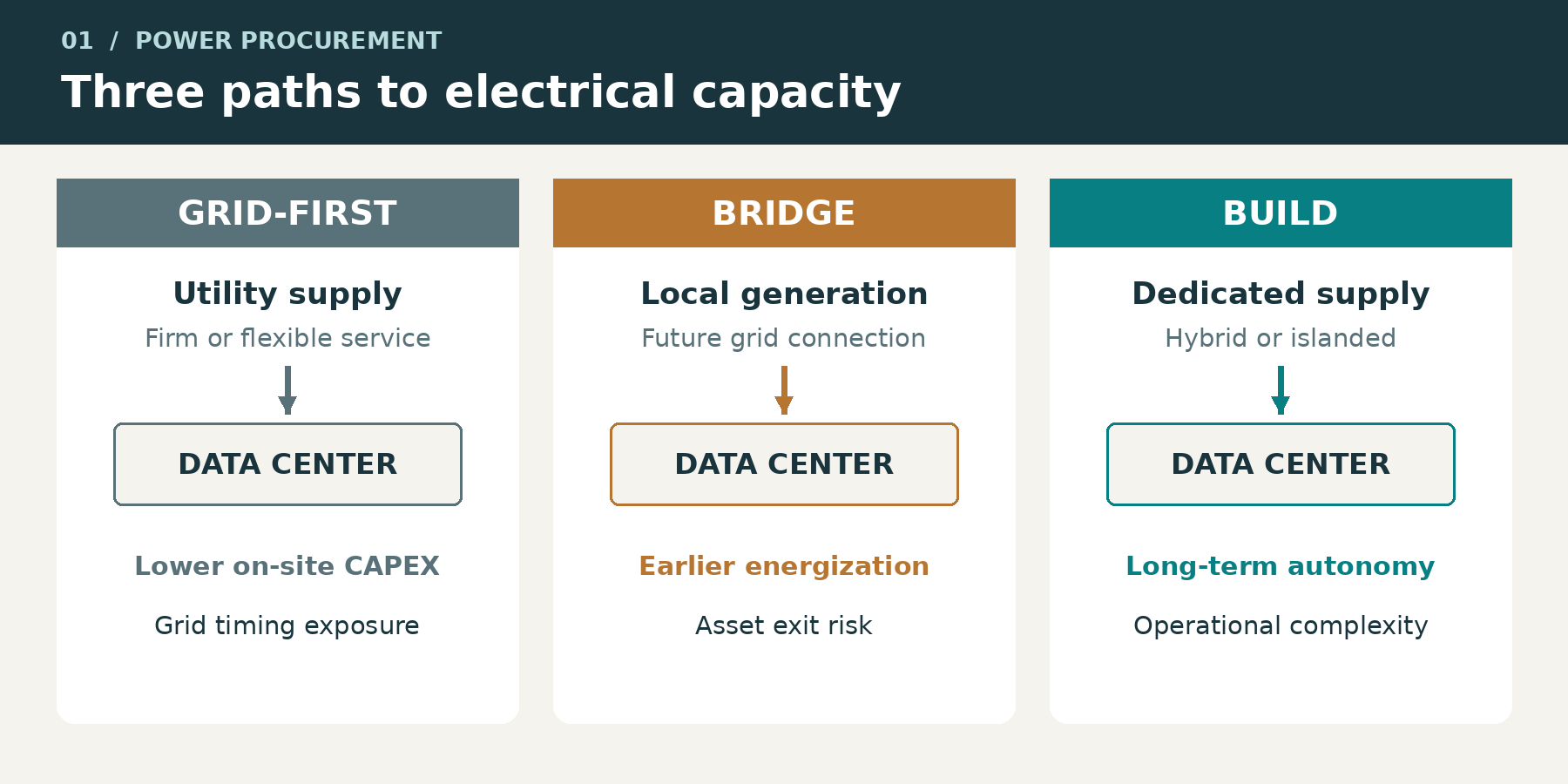
Developers can use temporary bridge power, establish permanent self-generation, or combine local resources with utility service. EPRI identifies bridge-to-grid strategies as a potential means of accelerating energization while retaining the long-term advantages of grid connectivity [2].
2. The emergence of a new electrical architecture
Consider a hypothetical data center with 100 MW of IT capacity and a power usage effectiveness (PUE) of 1.25. Its total facility requirement becomes approximately 125 MW. Supplying that demand through dedicated generation requires more than installing generators: it requires medium-voltage distribution, transformers, protection, energy storage and coordinated controls.
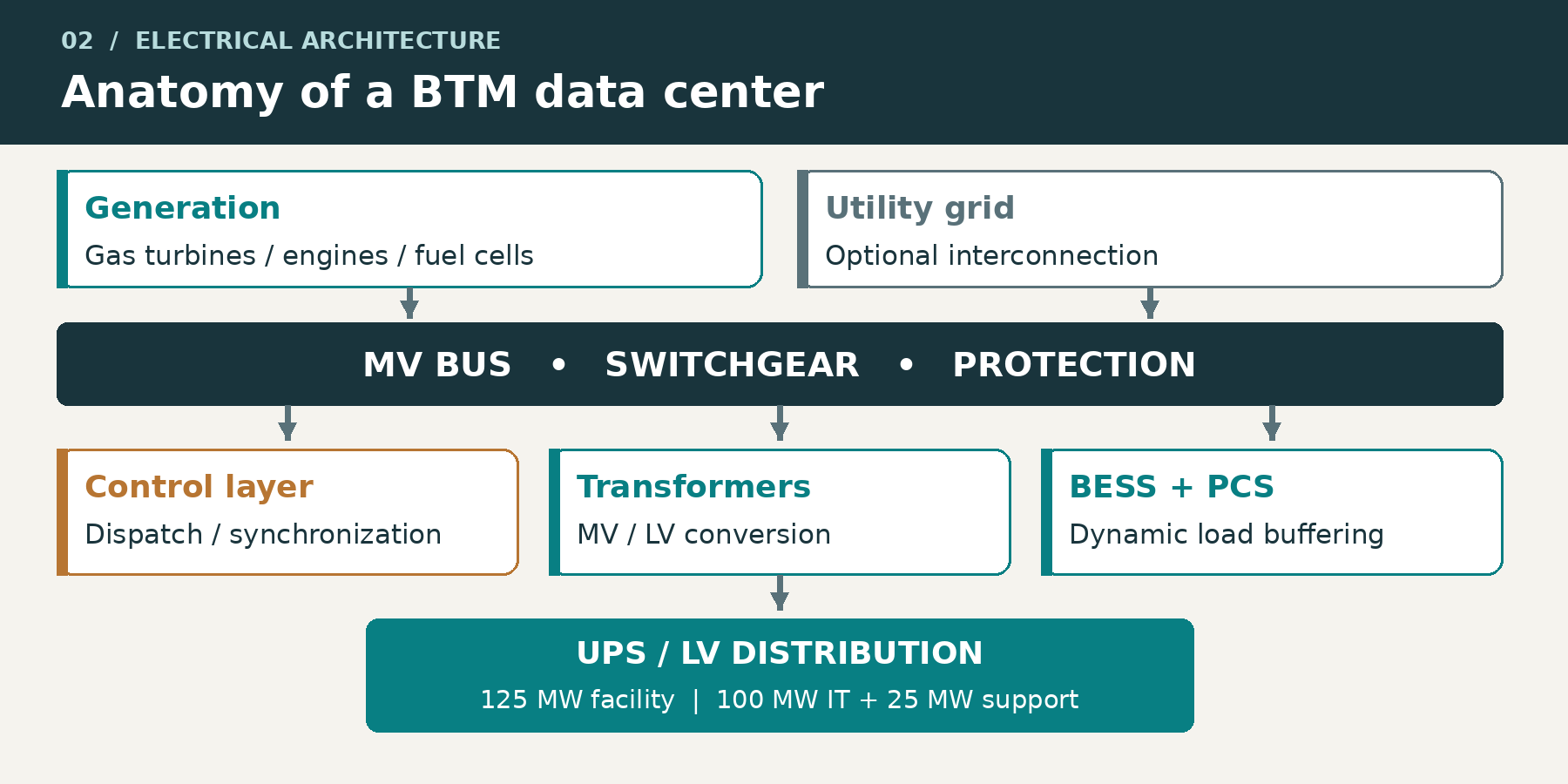
Gas turbines, reciprocating engines and fuel cells offer different combinations of scalability, efficiency, deployment speed and operational flexibility. Battery energy storage can support transient loads, source transitions and power stability. It complements generation rather than replacing sustained energy supply.
Commercial activity is already visible. GE Vernova’s agreement to supply Crusoe with 29 aeroderivative gas turbine packages illustrates demand for packaged generation at AI infrastructure scale [3]. This is an equipment commitment, not evidence that all units are operational. For electrical manufacturers, the opportunity extends well beyond generation itself.
3. The economics of buying time
Traditional energy procurement focuses heavily on electricity cost per megawatt-hour. But delayed energization can mean delayed revenue, idle infrastructure and underutilized computing assets. Consider an illustrative 125 MW facility running at a 90% average load factor, with grid electricity priced at $70/MWh and BTM electricity at $100/MWh.
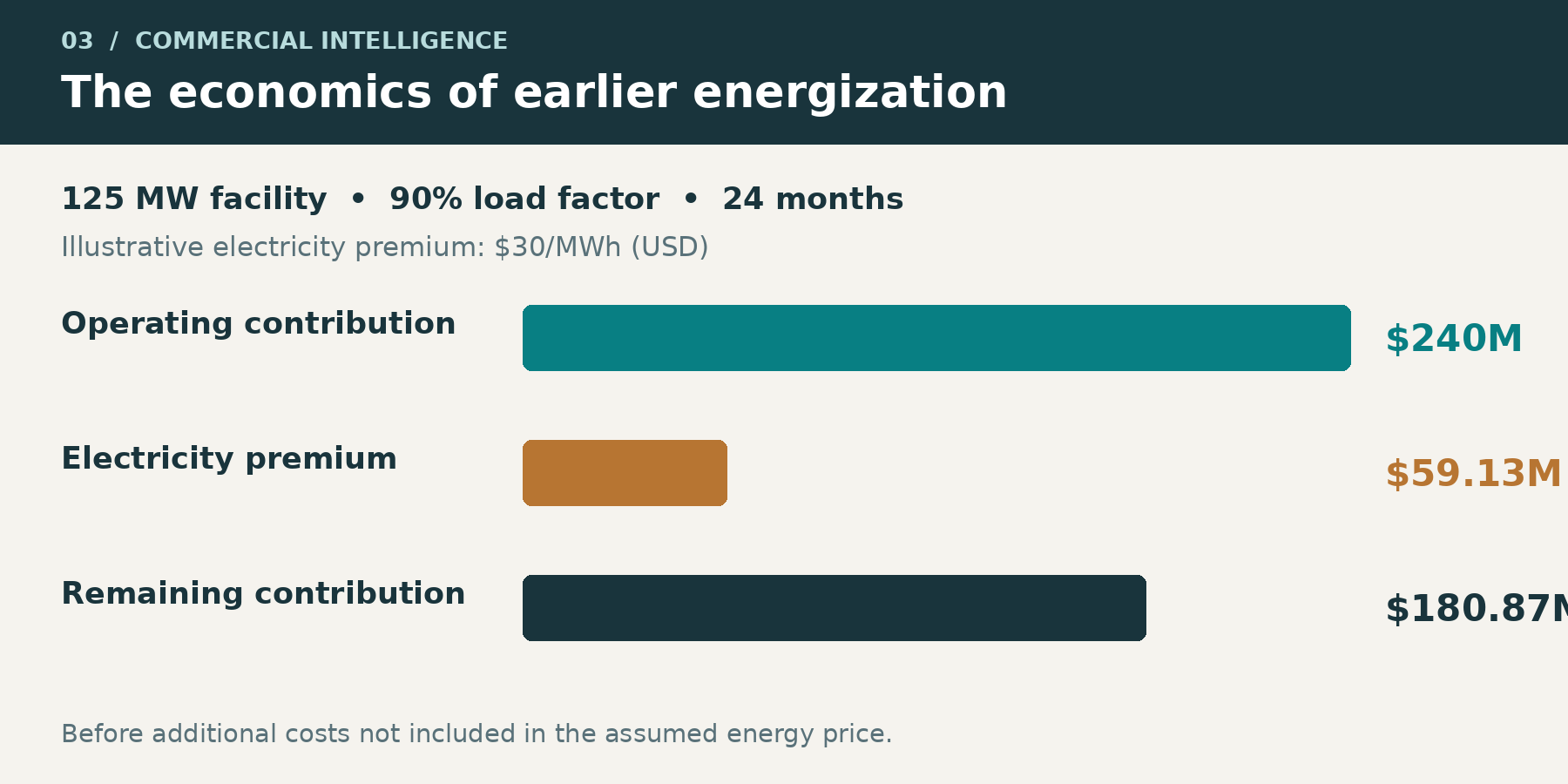
At a $30/MWh premium, the facility incurs about $59.13 million in additional electricity expenditure over two years (125 × 8,760 × 0.90 × 2 × $30). If earlier operation produces $240 million in contribution before that premium, the remaining contribution is $180.87 million, before other incremental costs not already included.
The calculation only works if computing hardware, cooling, customer demand and network infrastructure are also ready. An investment decision must incorporate financing, generation CAPEX, fuel-price exposure, operating expenses, residual asset value and risk-adjusted net present value, avoiding double-counting costs embedded in the energy price.
The objective is not necessarily to minimize electricity costs. It is to maximize the economic value of available electrical capacity.
4. What this changes for electrical OEMs
The transition toward dedicated generation could reshape the competitive priorities of electrical equipment manufacturers. A customer purchasing individual transformers, switchgear and protection devices may increasingly prefer coordinated infrastructure that reduces engineering and commissioning uncertainty. Four product strategy opportunities stand out.
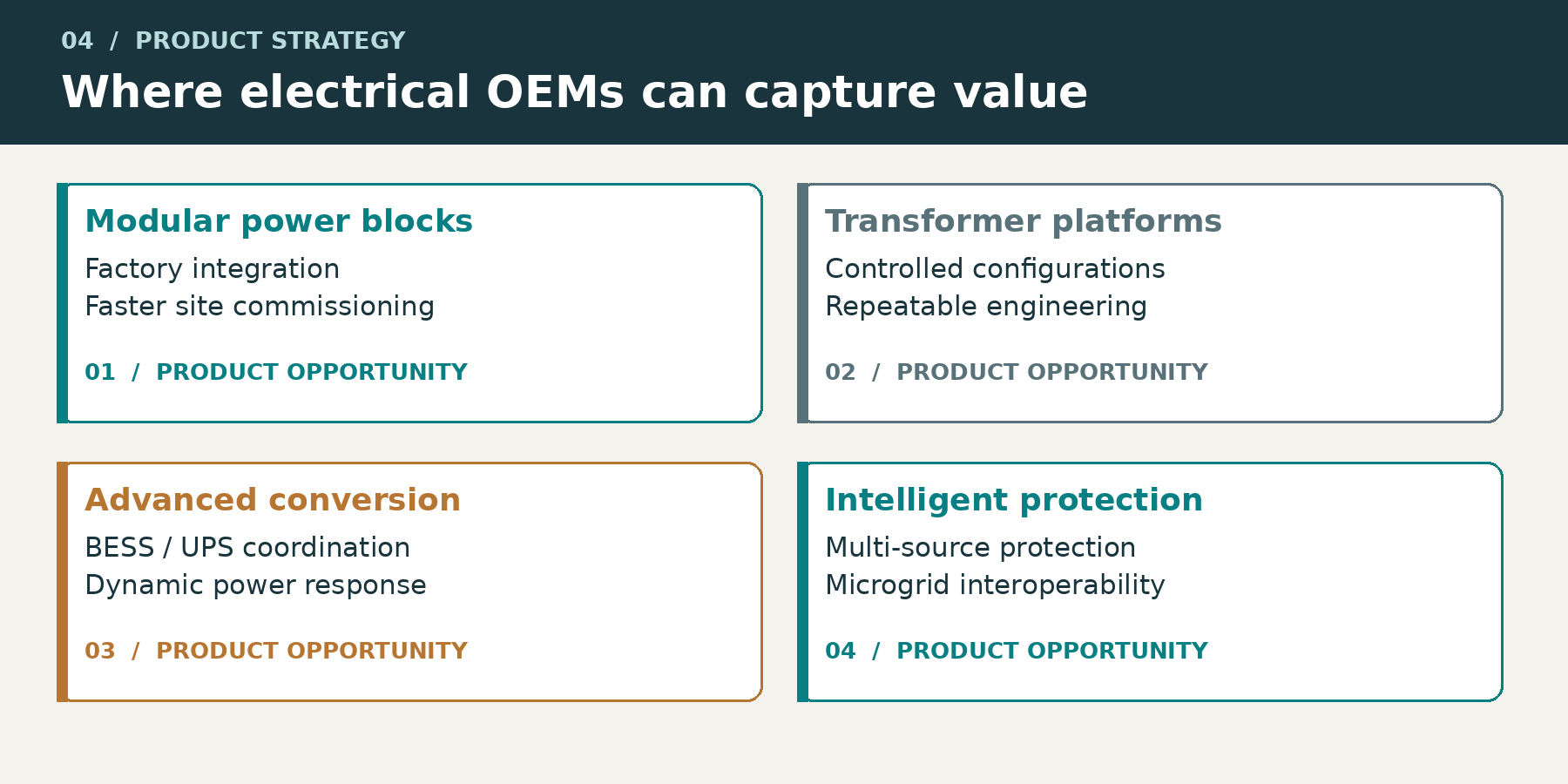
Modular electrical power blocks combine factory-integrated transformers, switchgear, protection and controls. Configurable transformer platforms use standardized designs with controlled electrical, thermal and mechanical variations. Advanced conversion coordinates storage, UPS and power electronics, including grid-forming functionality where the architecture requires it. Intelligent protection supports multiple sources and changing fault conditions.
Commercial differentiation could increasingly lie in interoperability, configuration flexibility and delivery predictability rather than component specifications alone. Manufacturers that reduce integration risk may capture more system-level value while creating opportunities in monitoring, maintenance and lifecycle services.
5. The risk of solving one bottleneck by creating another
BTM is not universal. It can replace utility connection uncertainty with dependencies on gas infrastructure, generation equipment availability, environmental permitting and operational complexity. It also creates stranded-asset risk: if utility power arrives after three years, what happens to a generation plant designed to operate for decades?
The interconnected grid provides diversification, shared reserves and a broader generation portfolio. Reproducing these benefits within an isolated system can be expensive. RMI identifies faster grid-connected alternatives, including flexible service, that could reduce the need for dedicated gas generation [4]. Even redundant generation remains vulnerable to shared fuel, controls and distribution failures. BTM must therefore be evaluated as a lifecycle infrastructure decision.
6. The WAIT–BRIDGE–BUILD framework
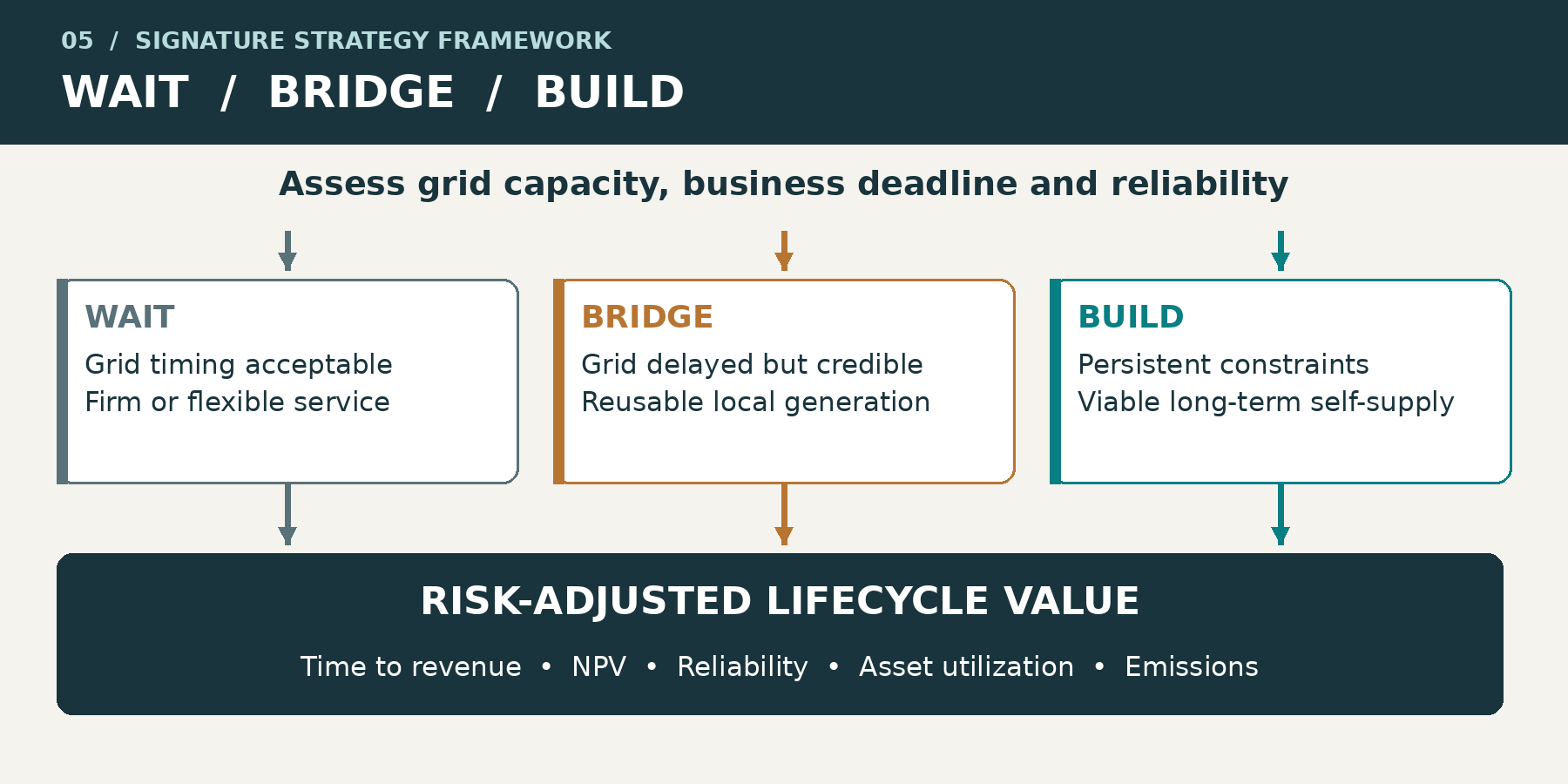
WAIT: prioritize utility connectivity where the timeline is commercially acceptable. BRIDGE: deploy temporary or reusable generation where earlier operation creates sufficient economic value and future grid access remains credible. BUILD: invest in permanent self-generation or hybrid infrastructure where persistent limitations justify long-term ownership.
The winning strategy is not necessarily the fastest immediate solution. It is the architecture that creates the greatest risk-adjusted value over the facility’s economic life.
Final perspective
Electricity is no longer merely an operating expense for AI infrastructure. Access to reliable electrical capacity has become a strategic enabler of growth. For electrical OEMs, integrated, scalable and configurable infrastructure offers a route beyond component-level optimization.
The next competitive advantage in AI infrastructure may not be measured exclusively in computing performance or electricity cost. It may be measured in the time required to turn megawatts into revenue.
Research and references
[1] IEA (2026), Key Questions on Energy and AI — Executive summary
[2] EPRI, Speed to Power Data Centers — Bridge-to-Grid
[3] GE Vernova, 29-unit aeroderivative turbine agreement with Crusoe
[4] RMI (October 27, 2026), The Case for Grid-Connected Data Centers
Arc & Margin explores the intersection of electrical infrastructure, technology, product strategy and commercial decision-making. Follow Arc & Margin for independent techno-commercial insights.
