
Estimated reading time: 6 min
A utility buying medium-voltage equipment has to price what happens on the substation floor.
One word in an 11 kV switchgear tender from Malta is worth a second look: extensible. In April 2026, Enemalta invited bids for SF₆-free ring main units, switches and circuit breakers under a framework it estimated at €3.06 million. The gas requirement gets the attention. But extensibility tells you something about the customer. The utility is buying equipment it expects to be able to expand. A supplier could remove the gas and still miss the reason this particular product belongs on the shortlist. [04]
The subject has a timely headline. On November 19, the European Union joined the Global SF₆ Pledge at COP31. By then, European buyers were already specifying equipment under the EU’s F-gas regulation. A Slovak distribution operator had published a procurement for SF₆-free switchgear earlier that same month. These are buying signals. Neither notice tells us what buyers ultimately paid, how many units shipped or which suppliers earned an attractive margin. [01] [03] [05]
For a product manager, the more interesting question starts when two offers clear the environmental requirement. What would make an engineer choose one of them, defend the decision to procurement and order it again for the next ten sites?
Ask what happens when the contacts open
A ring main unit brings several distribution functions into a compact assembly. The ring feeders can switch load current. The branch feeding a transformer also needs fault protection, which might come from a circuit breaker and relay or from a switch–fuse combination. Insulation and interruption do different jobs. One keeps energized parts separated. The other extinguishes the arc when a current-carrying contact opens. The tender needs an answer for each function. [07] [12] [16]
ABB’s UniSec family shows how easy it is to miss the distinction. Conventional UniSec is described as air-insulated, yet its switch disconnector uses SF₆. In UniSec Air, the corresponding device uses dry air for insulation and vacuum for interruption. An engineer who copies “air-insulated switchgear” from an old specification has left an important question unanswered. City Power Johannesburg’s published RMU schedule offers a practical fix: it asks separately about insulation and interrupting media. [07] [14]
| On the bid sheet | What the reviewer needs |
|---|---|
| Insulation | The medium in each relevant compartment and device. |
| Switching and protection | The interrupting device and rated duty of each feeder function. |
| Installation | The tested assembly, its access conditions and the drawing for the offered lineup. |
That distinction matters legally as well. The EU’s general rule for covered medium-voltage distribution equipment rated up to and including 24 kV applies from January 1, 2026. It addresses fluorinated gases in either the insulating or breaking medium. An SF₆-free label alone leaves open whether another covered gas is present. The corresponding date for equipment above 24 kV through 52 kV is January 1, 2030. Both bands have defined derogations. [01] [02]
A narrower cabinet can be harder to fit
Imagine a replacement at a street-level substation. The buyer has the equipment voltage, feeder configuration and two cabinet drawings. One unit is narrower. Should it get the higher score for fit? That depends on which wall, cable trench or access route sets the limit.
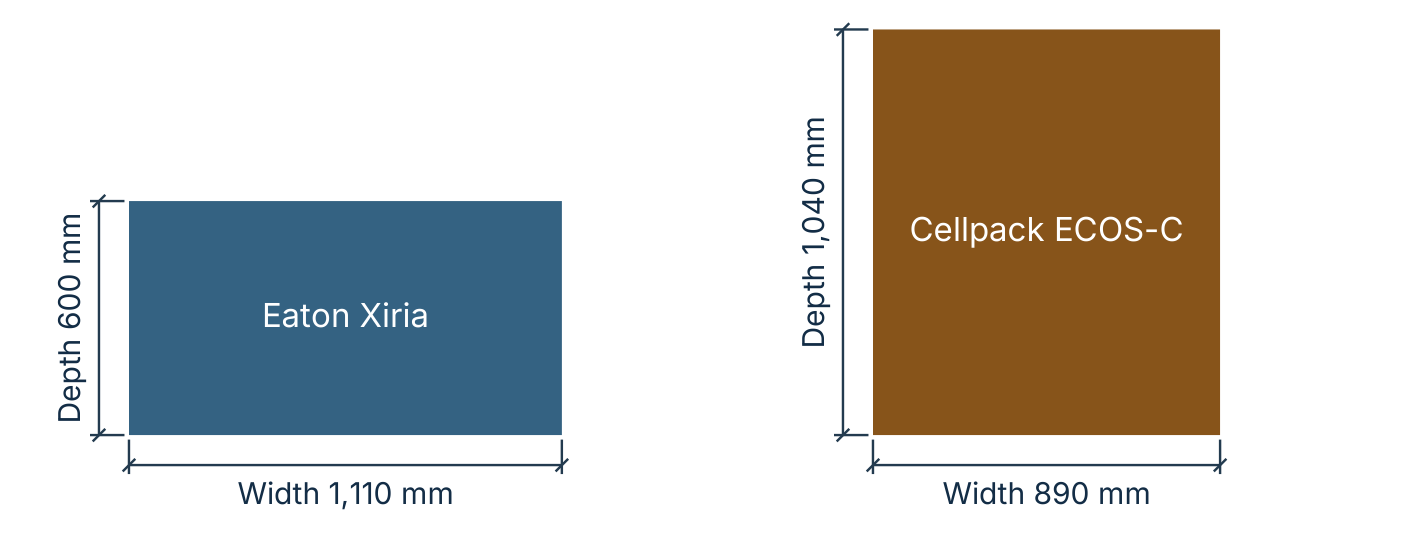
The dimensions in the figure come from a German government-commissioned study. The Eaton Xiria was 1,110 mm wide and 600 mm deep. The Cellpack ECOS-C was 890 mm wide and 1,040 mm deep. Choosing the Cellpack configuration would save 220 mm of width and require 440 mm more depth. Both figures describe the equipment envelope. Neither tells the crew where the cable terminations will land, whether the door can open fully or how much of the aisle remains available. Modern bids need current drawings, but the old comparison still makes an excellent case for surveying the room before ranking the offers. [13]
Sometimes that survey will find very little to change. Siemens says its 8DJH 24 blue GIS retained the compact dimensions of its SF₆ predecessor. For a fleet built around that particular arrangement, an engineer has a good reason to examine the successor first. There is still a drawing to check. The manufacturer’s catalog shows different feeder blocks and optional extensions, and the relevant comparison is the configuration that will arrive on site. [16] [17]
How many sites need to benefit?
Consider an illustrative rollout of 40 sites. Two designs meet the electrical duty. Assume both will qualify, but the second costs €600 more per site and requires €15,000 of additional one-time qualification work. Where its layout avoids cable or civil modifications, assume it saves €4,000. Across the rollout, the buyer needs to recover €39,000. Ten avoided modifications would just cover the difference.
| Sites avoiding work | Avoided cost | Net saving with second design |
|---|---|---|
| 5 of 40 | €20,000 | −€19,000 |
| 10 of 40 | €40,000 | +€1,000 |
| 20 of 40 | €80,000 | +€41,000 |
Now change one assumption. If the avoided work costs €2,000 per site, twenty sites have to benefit. That one estimate can reverse the purchasing decision. Before negotiating the cabinet premium, I would ask the site team to mark the buildings that actually require modifications and the contractor to price a representative example. A spreadsheet gets much more persuasive when someone can point to the cable trench behind the number.
There is a fair counterargument. In a new substation with ample space, several qualified suppliers and a layout the designer can still change, the cheaper standard offer may be the right answer. A supplier that invests in a costly retrofit capability needs to know how often it bids on constrained buildings. The useful sales forecast starts with a count of those buildings.
What earns the repeat order?
There is one more detail for procurement. During the first two years of the EU restriction for the lower MV band, receiving qualifying F-gas-free offers from only one manufacturer can matter under a specified derogation. Two resellers bidding the same manufacturer’s equipment still represent one manufacturer. The Commission’s guidance explains the conditions, the lower-GWP tier and the records the operator must keep. A buyer evaluating a second source should record who actually makes each offered assembly. [01] [02]
For manufacturers, I would put one investment ahead of another catalog variant: a complete submission for the feeder arrangement the utility buys repeatedly. Include the device-level gas declaration, configuration-specific drawings, relevant test evidence, known extension limits and a local service plan. Then measure how often that package clears technical review without another round of engineering. When a bid stalls, record the specific reason. A missing test report calls for a different investment from an enclosure that forces the buyer to rebuild a room. Over several tenders, those records can tell the product team where to spend its next engineering dollar.
Enemalta’s word “extensible” is a good place to finish. Put the future feeder on the drawing. Show the buyer where it will connect, what space it needs and which work can be avoided when it arrives. That gives procurement a reason to value the feature today, and engineering a reason to specify the product a second time.
Selected sources
EU regulation and Commission guidance [01] [02] · COP31 announcement [03] · Enemalta and Slovak procurement records [04] [05] · City Power and IEC [07] [08] · European Commission technical assessment [12] · Ecofys / ETH [13] · ABB and Siemens [14] [16] [17]. Bracketed references link to the originals.
Subscribe to Arc & Margin for new research on electrical infrastructure and product strategy.

